Community Benefits
-
Farmington River Heritage Trail Connection to be constructed by Developer
-
Public access to Farmington River Trail Connection
-
Bridgewater Road Extension
-
Positive Fiscal Impact
-
Wetland improvements and protections
-
Reuse of gravel pit to resolve current land use and environmental issues
-
Removal of construction debris and related materials
-
Incorporates many Objectives of the Plan of Conversation and Development including acquiring riverfront land without costs.
-
Stormwater management and enhanced water quality
-
Improved protection of the Farmington River
-
Best Management Practices incorporated into the final development plan
-
Existing Conditions-Improvement of gravel Pit (zoned Earth Excavation Zone)
Farmington Canal Heritage Trail Connection
-
No development is allowed within the 100’ buffer from the Farmington River
-
Farmington River Trail Connections are allowed within the river buffer
-
Proposed public trail provides access along the Farmington River
Trail Completion Expected to Boost Jobs and Local Spending
A recent economic analysis shows that completing the full New Haven–to–Massachusetts trail system could generate significant community benefits, including increased local spending, new jobs, and higher long-term property values throughout the region. To learn more about how this project supports the vision for the Enclave at the Farmington River, read our full update.
Source Note
Summary based on an economic impact analysis by Cambridge Econometrics of the Farmington Canal Heritage Trail and East Coast Greenway network.
Bridgewater Road Extension
-
Development includes road extension to cul de sac behind the CT Temple
-
Provides alternative access to Route 4
Positive Fiscal Impact
-
Goman-York School Enrollment/Economic Impact concludes positive net revenue
-
Net revenue to community estimated at 1.6M
Excerpt-Town of Farmington Plan of Conservation and Development
“Farmington’s dependence on the local property tax will become a much more significant issue. Due to the lack of vacant commercial and industrial land and declining housing starts, annual growth will continue to decline, property values may decline, and the fixed costs of government will continue to increase. All of this will occur as the state continues to cut financial support to municipalities.”
Wetland Improvements, Protections and Soil Remediation
-
Wetland on the Farmington River parcel were previously disturbed
-
Actions were required to restore past wetland incursion issues
-
Wetlands were delineated in 2024-2025
-
Conservation and Inland Wetlands Commission approvals required
-
Soil Remediation and reclamation of former gravel pit
-
Reuse Of gravel pit to Resolve current Land use and environmental issues
Riverfront Land Conveyance to Farmington
A substantial portion of the site is proposed to be conveyed to the Town of Farmington with open spaces in perpetuity. Acquiring additional open spaces along the Farmington River is referenced as a long-term objective in the Farmington Plan of Conservation and Development.
Stormwater Management
SLR civil engineers incorporated sound stormwater management practices, including low impact development techniques, in an effort to maintain water quality and natural landscapes. The Site will be designed to meet:
-
Connecticut Department of Energy & Environmental Protection (CTDEEP)
-
Specification from 2024 Connecticut Stormwater Quality Manual
-
Comply with the requirements of the 2024 Connecticut Guidelines for Soil Erosion and Sediment Control.
Strict Protection of the Farmington River
This criterion requires thoughtful planning and strict adherence to environmental protections surrounding the Farmington River including:
-
Careful placement of improvements into the natural landscape
-
Promotion of innovative landscaping plans, with an emphasis on replacing invasive plant species with indigenous plant species
-
Preservation of unique vegetation and wildlife habitat
-
Conformance with floodplain, inland wetland and watercourses, and aquifer protections regulations.
-
Designed to meet the requirements of all floodplains, wetlands, and aquifer regulations.
The Enclave at the Farmington River Master Plan was designed with the Site’s environmental characteristics and an appropriate landscaping plan has been designed to include invasive species removal.
Best Management Practices
While the State of Connecticut primarily regulates commercial, industrial, non-residential, and hazardous-materials-related activities within aquifer protection areas, many of the recommended Best Management Practices (BMPs) are also relevant to residential properties. These BMPs will be evaluated and incorporated into the final development plan where appropriate: The following guidance documents will be referenced during site design and BMP integration:
-
Connecticut Department of Energy and Environmental Protection (DEEP)
-
Best Management Practices for controlling stormwater from parking lots
-
DEEP Aquifer Protection Area Guidance Regulations
-
Best Management Practices for disposal of snow accumulations from roadways and parking lots
-
Temporary Construction and Reconstruction Operations in Aquifer Protection Areas
-
Location and Maintenance of Dumpsters Relative to Public Water Supply Wells
FEMA Mapping
The site is located with FEMA-designated Flood Zone AE, as shown on Flood Insurance Rate Map (FIRM) Panel 09003C0476F, effective September 26, 2008. Flood Zone AE represents areas with a 1% annual chance of flooding, often referred to as the 100-year flood zone, and classified as a Special Flood Hazard Area (SFHA). Zone AE areas include base flood elevations calculated and established through detailed FEMA hydrological and hydraulic studies. For properties within SFHAs that are financed through federally backed mortgages, flood insurance is typically required under the National Flood Insurance Program (NFIP).
Updated Preliminary FIRM Panel 09003C0476G, issued on June 29, 2023, also covers the site. FEMA published a legal notice on April 16, 2025, announcing the start of the 90-day appeal period. The period allows property owners and the municipality to review the Preliminary FIRMS and the accompanying Federal Insurance Study (FIS) and to submit comments. After the appeal period closes, FEMA will evaluate all comments and issue revised preliminary maps, if changes are needed.
FEMA will issue a Letter of Final Determination, initiating a six-month adoption period during which the community must adopt or amend its floodplain management ordinance to reflect the updated mapping. According to notices posted on the Town of Farmington’s Planning and Zoning webpage, the effective date of the final maps from FEMA is tentatively anticipated in late 2026 or early 2027.
New FEMA Map
FEMA’s preliminary flood mapping products indicate a reduced overall extent of the 100-year floodplain on the property compared to the currently effective FIRM panel. Under the preliminary FIRM, the100-year floodplain is limited to areas immediately adjacent to the Farmington River and the freshwater ponds located on the southern portion of the property. The preliminary FIRM also removes portions of the property that were previously mapped within the 500-year floodplain, which represents areas with 0.2% annual chance of flooding. This includes areas in the western portion of the property that are currently occupied by the former gravel pit and proposed development.
FEMA Mapping | Town of Farmington, CT
Existing Conditions-Improvement of Gravel Pit-Zoned Earth Excavation
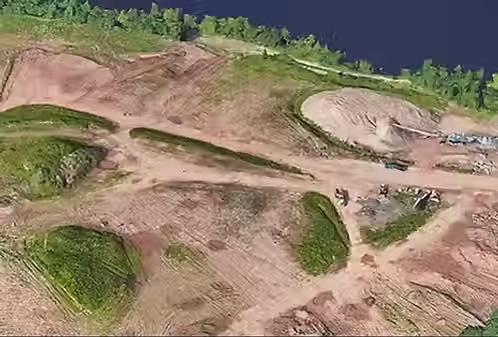
The land parcel is adjacent to the Farmington River without public access. The site has been used for quarrying and related industrial/extractive activities. It currently contains construction equipment and materials. Topography is considered to be post-extraction state. Truck traffic continues including construction machine transport. The land is underutilized and no access exists to the Farmington River.
Access Current Site Conditions on Google Earth
-
Open Google Earth in Chrome
-
Type Address to see the current condition of the gravel pit
-
Select 3D
1179 Farmington Avenue, Farmington, CT
Scroll down to see the gravel pit, machinery, debris, and gravel excavation areas.
Plan of Conservation and Development (Summary Excerpt-POCD)
“The Town has acquired over 2,200 linear feet of river frontage through the purchase of open space land. The acquisition of additional riverfront land continues to be one of the highest priorities of the Town’s Land Acquisition Committee”.
Development Summary
Development Sites
The Waterside site was comprised of 28-acres of undeveloped land. Previously, a 120-unit assisted living facility was completed resulting in approximately 12-acres available for additional development.
The parcel, Plant 17, situated on the Farmington River is approximately 60-acres and is currently classified as Earth Excavation Zone. Current uses are storage and processing construction materials. Previously, it operated as an excavation site and gravel pit. There is no public access to this site. There have been various environmental and watershed intrusion issues over the years. Development will address the environmental and watershed issues. Substantial open space is proposed for residents and the public.
Public Access to the Farmington River
There is no public access to this site. Site development will provide both open spaces and public access.
Fiscal Impact-Excerpt from POCD
Farmington’s dependence on the local property tax will become a much more significant issue. Due to the lack of vacant commercial and industrial land and declining housing starts, annual growth will continue to decline, property values may decline and fixed cost of government will continue to increase. All this will occur as the state continues to cut aid to municipalities
Population Growth-Excerpt from POCD
Farmington has seen its growth period and in reaction has spent millions of dollars preserving open space.
Farmington’s population growth has now leveled off and is projected to remain fairly constant with little, if any growth in the future.
There will be fewer and fewer single-family homes constructed as the amount of developable land declines. The household size will continue to decline and Farmington’s population will be much older starting in 2025 with a 30% increase in the over 60 age groups.
Net Positive Fiscal Impact and Large Land Dedication
Goman and York estimated $1.6M annual positive net fiscal impact/estimated $1.1M in one-time fees

Current Conditions